Network comparison
Solana vs Ethereum
A technical network comparison for teams choosing between Ethereum's settlement-and-rollup economy and Solana's integrated high-throughput L1.
Solana vs Ethereum is not a speed contest
The useful comparison is not 'fast chain versus serious chain.' Ethereum and Solana are different answers to the same hard question: how should a public blockchain sell trust, throughput, developer leverage, and user experience at the same time?
Ethereum's answer is layered. It protects the base layer as a high-legitimacy settlement environment, lets rollups absorb more execution, and keeps the EVM as the largest smart-contract labor and standards market. That is messy for users, but powerful for institutions, auditors, wallets, custodians, and DeFi teams that care about composability and capital depth.
Solana's answer is integrated. It pushes more performance into one primary L1, uses a high-throughput runtime and validator economy, and tries to make onchain interaction feel less like bridge management. That is better for consumer apps, games, fast trading, mints, social products, and flows where fees must disappear into the background.
Market snapshot (May 28, 2026)
These values are populated from the shared market-data snapshot. Builds can refresh the data from CoinGecko and DeFiLlama with RANKER_REFRESH_MARKET_DATA=1.
| Metric | Solana | Ethereum | Read |
|---|---|---|---|
| Market cap | $47.8B | $244.0B | Ethereum remains the larger reserve-infrastructure asset; Solana remains the higher-beta performance challenger. |
| Market-cap rank | #7 | #2 | The rank gap still changes boardroom comfort, exchange assumptions, and treasury risk. |
| 3-month market-cap change | +2.59% | +4.67% | The exact number moves, but the relative trend helps separate durable network thesis from short-term token heat. |
| 30-day token price change | -1.10% | -11.70% | Useful as context only; product architecture should not be chosen from a one-month chart. |
| DeFiLlama chain TVL | $5.24B | $42.2B | Ethereum's capital depth is still the hardest thing for other L1s to copy. |
Ethereum optimizes for legitimacy first
Ethereum's strongest technical asset is not raw throughput. It is the credibility stack around the protocol: proof-of-stake finality, multiple execution and consensus clients, EIPs, ERC standards, mature wallet integrations, a large audit market, and a huge base of production incidents that have turned into shared engineering knowledge.
Ethereum's proof-of-stake model makes validator capital explicitly slashable for dishonest behavior. Validators run execution, consensus, and validator clients, attest to blocks, and participate in finality through checkpoint voting. That machinery is expensive to understand, but it is legible to serious risk teams.
The weakness is also obvious. The modern Ethereum product path often means L1 plus rollups plus bridges plus account abstraction plus cross-domain messaging plus wallet UX. Ethereum is the strongest settlement environment in this comparison, not the cleanest consumer product surface.
Solana optimizes for product feel first
Solana's strongest asset is that it can make onchain actions feel closer to normal software. Low fees, fast confirmations, a single dominant execution environment, and a performance culture around Agave, Jito, Firedancer, schedulers, account locks, and validator throughput change what builders can ask users to do.
That performance comes with a real cost. Solana validators need more serious hardware, bandwidth, and operating discipline. The validator set can be real and still more economically filtered than Ethereum's home-staking story. Solana also has no in-protocol slashing implementation today, so the accountability model leans more heavily on delegation, reputation, and ecosystem pressure.
The right critique of Solana is not that it is unserious. The right critique is that its speed is paid for in validator economics, runtime complexity, and a narrower developer labor market than the EVM world.
Consensus, validator, and client comparison
This is the machinery that should matter before anyone argues about token tribes.
| Layer | Ethereum | Solana | Practical implication |
|---|---|---|---|
| Consensus identity | Proof-of-stake with validator attestations, proposer duties, slashing, and finalized checkpoints | Delegated proof-of-stake with high-throughput validators, vote accounts, leader scheduling, and epoch rewards | Ethereum is easier to defend to conservative risk teams; Solana is designed around keeping the product surface fast. |
| Client diversity | Multiple execution and consensus clients reduce single-implementation risk | Agave/Jito dominate today, with Firedancer and related work improving diversity | Solana's client-diversity direction is improving, but Ethereum has the more mature multi-client story. |
| Validator economics | Capital stake and slashing are central to the security story | Performance, stake delegation, commission, uptime, and hardware economics are central | Solana decentralization diligence must include operator economics, not just validator count. |
| Failure mode | Fragmented UX and L2 coordination risk | Runtime complexity, congestion edges, and concentration concerns | The chain decision is really a choice of failure mode. |
EVM vs SVM changes the build, not just the syntax
Developer language is only the surface. The execution model changes hiring, audits, indexing, composability, and operational risk.
| Build dimension | Ethereum / EVM | Solana / SVM | What it changes |
|---|---|---|---|
| Dominant language | Solidity plus a large EVM tooling ecosystem | Rust for Solana programs, commonly with Anchor or lower-level program design | EVM hiring is easier; Solana expertise is more specialized and harder to fake. |
| State model | Contracts and storage with mature ERC token standards | Programs and accounts, with explicit account access and parallelism constraints | Solana requires better up-front account design; Ethereum gives teams more standard patterns. |
| Scaling path | Rollups, L2s, data availability, bridges, and settlement on Ethereum | One integrated L1 experience with performance pushed into the base system | Ethereum requires an L2 thesis; Solana requires confidence in the base-layer performance model. |
| Audit posture | Large Solidity audit market and long exploit history | Smaller but serious Solana security market with different bug classes | An EVM audit process does not automatically transfer to Solana. |
Choose Ethereum when the risk surface is capital-heavy
Ethereum is the lower-regret default when the user, investor, or compliance team cares more about legitimacy than consumer speed.
- Tokenized assets, stablecoin rails, RWA products, treasury systems, and institution-facing DeFi usually benefit from Ethereum's liquidity and standards.
- Teams that need ERC-20, ERC-721, ERC-1155, exchange support, custodian familiarity, and auditor supply should not casually leave the EVM world.
- Infrastructure products that sell into wallets, indexers, analytics, audit, custody, or cross-rollup systems usually find more buyers in Ethereum's broader economy.
- If the answer to 'why not Ethereum?' is only 'fees,' the real answer may be an Ethereum L2 rather than a different L1.
Choose Solana when interaction frequency is the product
Solana is the better starting point when the product feels broken if every action is slow, costly, or bridge-aware.
- Trading interfaces, games, mints, social apps, payment-like flows, loyalty products, and mobile-native crypto apps can benefit directly from Solana's low-fee UX.
- Teams that want one primary execution environment instead of an L1/L2/bridge decision tree get a cleaner product surface.
- Solana is a better fit when user behavior is high-frequency and low-value per action, because Ethereum mainnet economics are usually the wrong frame.
- A serious Solana build needs actual SVM and Rust fluency; an EVM agency with a Solana landing page is not enough.
The market-positioning read
Ethereum is easier to underappreciate because the product story is no longer one page. The real Ethereum stack is base settlement, rollups, standards, clients, auditors, wallets, node providers, MEV infrastructure, and institutional trust. That makes it awkward and durable at the same time.
Solana is easier to over-simplify because the speed story is visible. The harder read is that Solana is building a professional performance network where validator economics, client diversity, Jito, RPC, indexing, and app-level fee strategy are all part of the product.
For a serious team, the answer should be framed as architecture fit. Ethereum is the capital and standards default. Solana is the consumer-performance default. Both can be right; the expensive mistake is choosing either one because of ideology instead of workload.
Solana vs Ethereum FAQ
Short answers to the questions that usually hide the real architecture decision.
Is Solana better than Ethereum for developers?
Solana is better for developers building low-fee, high-frequency user experiences. Ethereum is better for developers who need the deepest smart-contract tooling, audit market, EVM compatibility, and institutional trust.
Is Ethereum safer than Solana?
Ethereum has the stronger conservative security narrative because of its mature proof-of-stake design, slashing, client diversity, and institutional history. Solana is technically serious, but its diligence questions are more focused on validator economics, client concentration, and performance complexity.
Should a startup build on Ethereum L2s or Solana?
Use an Ethereum L2 when EVM liquidity, wallet support, and Ethereum settlement credibility matter. Use Solana when the product needs one fast execution environment and repeated low-cost interactions.
Can an Ethereum agency build Solana apps?
Only if it has real Solana program experience. Solidity, EVM audits, and ERC token work do not automatically transfer to Rust, SVM accounts, Solana program constraints, and Solana-specific security review.
Sources behind this comparison
The page uses current market snapshots plus primary network documentation. Market values should be read as dated data, not permanent claims.
Used for market cap, market rank, 30-day token change, and 90-day market-cap change calculations.
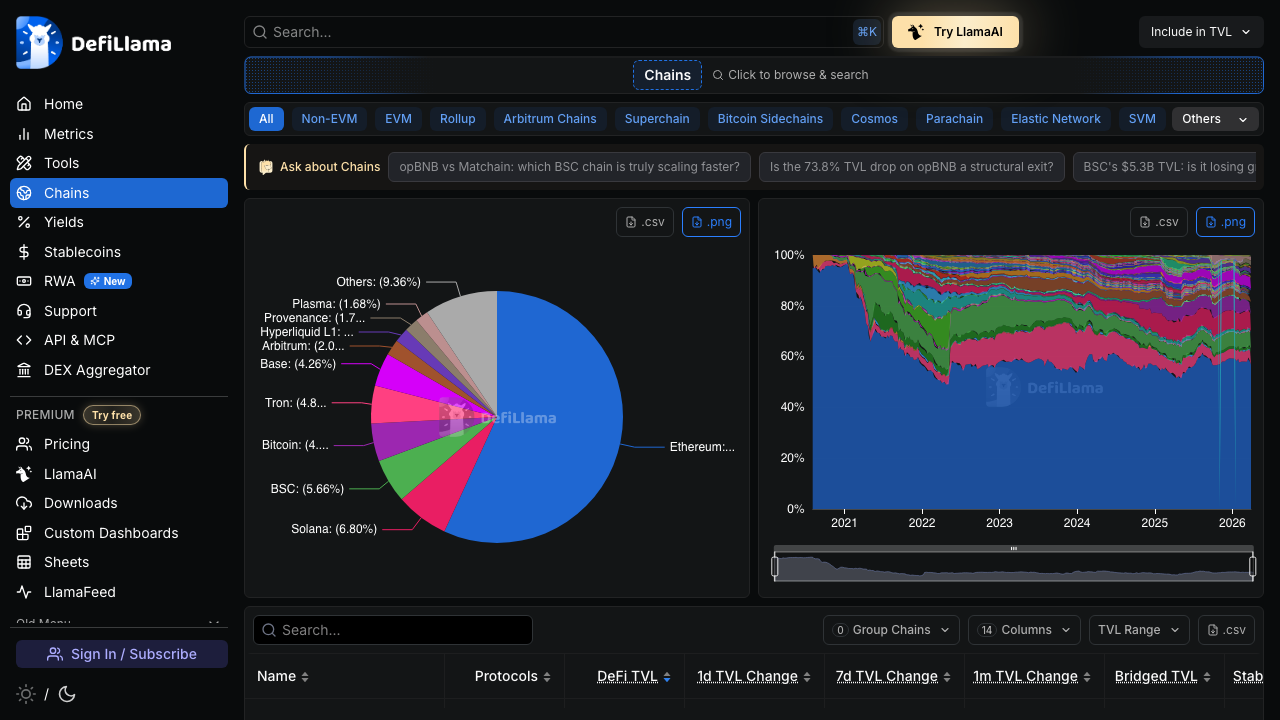
Used for chain-level TVL context.
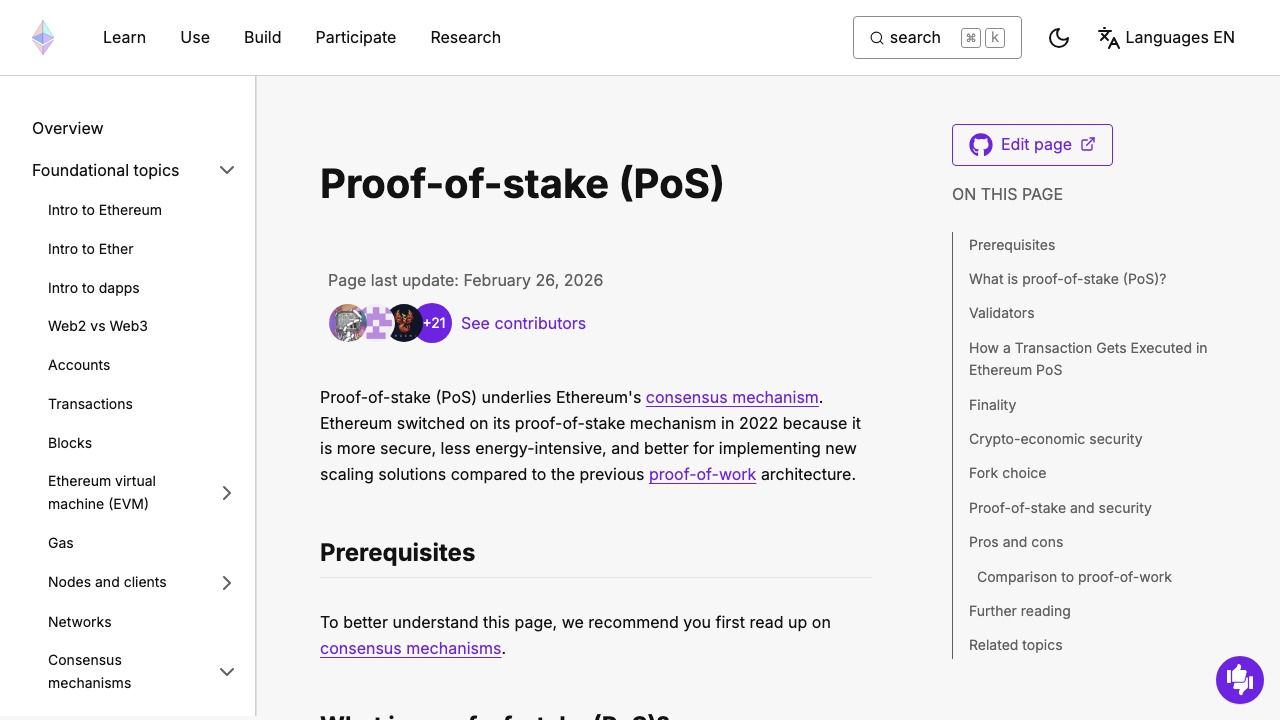
Grounds the Ethereum validator, slashing, attestation, and finality discussion.
Grounds the Solana delegation, validator reward, commission, and slashing discussion.
Useful for validator count, Nakamoto coefficient, client diversity, uptime, and developer context.
Used as directional open-source developer activity context.